Journal Publications Dr. Yunmei Liu Advances Quantitative Modeling of Automation and Situation Awareness
Ergonomics, 2025
Dr. Yunmei Liu is the first author of “Models of automation proportion in human-in-the-loop systems and operator situation awareness responses,” co-authored with David Kaber and published online in Ergonomics on December 28, 2025.
From Conceptual Understanding to Quantitative Design
Situation awareness (SA) is central to human–automation interaction, safety, and performance. Building on established SA and automation research, this paper contributes two advances that make these relationships more explicit and useful for system design.
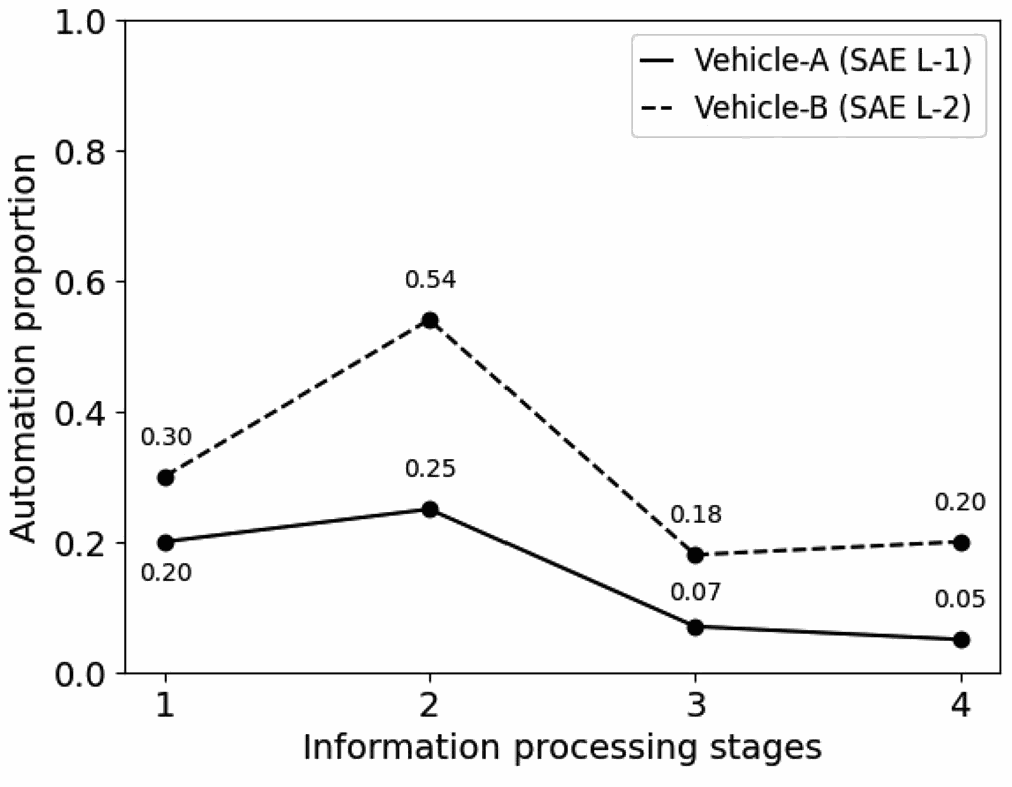
A formally defined, continuous automation proportion. A task-level, set-theoretic definition grounded in hierarchical task analysis and information-processing stages moves beyond discrete “levels of automation.” It provides a continuous, reproducible measure of how functions are allocated between people and automation, enabling more precise comparisons of system designs.
A parsimonious mathematical SA response model. An explicit response function links operator SA to automation proportion through interpretable parameters representing operator expertise and attitudes toward automation. It can represent both linear and nonlinear response patterns reported in prior empirical research, providing a starting point for quantitative SA modeling rather than a fully validated predictive model.
This work forms the theory and modeling foundation of Dr. Liu’s PhD dissertation. Empirical validation using a high-fidelity driving simulator is planned as a next step toward translating the framework into design guidance.