Journal Publications Dr. Yunmei Liu Leads Study on Virtual Reality for Prosthetic Control Evaluation
IEEE Transactions on Neural Systems and Rehabilitation Engineering, 2026
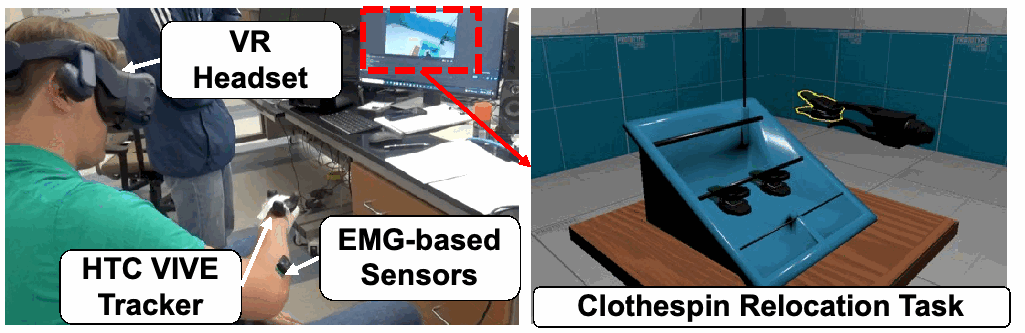
Dr. Yunmei Liu is the first author of “Virtual Reality as a Platform for Upper-Limb Prosthetic Control Modes Evaluation and Early-Stage Design,” published on January 12, 2026, in IEEE Transactions on Neural Systems and Rehabilitation Engineering.
Evaluating Prosthetic Interfaces in Virtual Reality
The collaborative study compared three prosthetic control modes in physical-device and virtual-reality settings, examining task performance, cognitive workload, and usability.
The results show that the suitability of VR depends on the control mode and available sensory feedback. Pattern-recognition control produced consistent performance across settings, while other modes showed differences in performance or workload. Usability ratings were broadly consistent. The work supports VR as a useful platform for early design evaluation while identifying opportunities to improve realism, including haptic feedback. It informs Dr. Liu’s continuing research on human-centered prosthetic interfaces and assistive technologies.
Read the publication in IEEE Transactions on Neural Systems and Rehabilitation Engineering